


Smart Cooling for Data Centers Efficiency
Mission Critical Cooling: System Design & Operation.
Smart Cooling is a precision-controlled intelligent pre-cooling system that stabilizes condenser inlet air temperature (T_in) of air-cooled chillers operating under high ambient conditions, without introducing surface moisture or mineral deposition on the condenser coil.


Precise condenser coil inlet-air temperature control with absolute minimum water consumption.
The atomized water evaporation process dramatically reduces water consumption. Read more
Designed for environments where cooling availability and predictability are critical, including:
- Hyperscale and colocation data centers
- HPC / AI GPU clusters
- Financial trading infrastructure
- Telecom and edge computing sites
- Industrial mission-critical facilities
Key engineering objectives:
Smart Cooling system is engineered to achieve the following objectives under mission-critical operating conditions

Stable condensing temperature in peak heat.

Reduced compressor pressure under high load.

Higher efficiency with lower compressor load.

Reliable operation in 40–50°C ambient conditions.
Adiabatic effect requires only micro-liters per cubic meter of air.
Typical data center operational consumption:
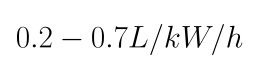
Water undergoes the following treatment and control steps:
- <5 μm filtration
- Pressure regulation
- Automatic purge cycles
- No direct contact with condenser surface
Water handling and quality safeguards:
- Closed-loop, non-recirculating atomization
- No concentration cycles (no blowdown chemistry)
- No mineral accumulation on heat-exchange surfaces
- Filtration and pressure regulation ensure stable droplet size
Water calculations estimation VS chiller COP – get test report here.
Air-cooled chillers typically operate with:
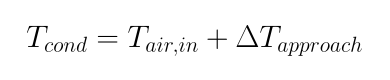
Where ΔT_approach = 10-18°C, depending on coil design.
| Parameter | Value without Smart Cooling | Value with Smart Cooling |
|---|---|---|
| Ambient DB | 42°C | 34°C |
| ΔT_approach | 12°C | 12°C |
| Condensing Temp (no pre-cooling) | 54°C | 46°C |
ΔT_condensing reduction = 8°C
This directly influences compressor discharge pressure:
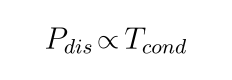
Practical field results (screw & scroll compressors):
- 8-12% reduction in discharge pressure
- 6-12 bar lower discharge in screw systems operating with R134a/R410A
Coefficient of Performance (COP) is defined as:
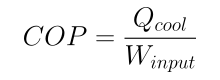
Higher COP translates to more cooling delivered per watt of power. Directly improves facility PUE and reduces operational OPEX.
Compressor power approximates to:
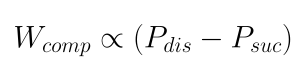
Lowering discharge-to-suction pressure differential directly slashes energy consumption and reduces mechanical stress on the compressor.
Compression ratio:
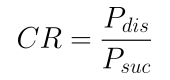
Minimizing the compression ratio reduces thermodynamic work and internal heat buildup, ensuring more stable and reliable long-term operations.
Lowering condensing temperature by 8°C reduces compression ratio
| Example (R410A screw chiller) | Before | After |
|---|---|---|
| Pressure | 26 bar / 7 bar | 22 bar / 7 bar |
| CR | 3.71 | 3.14 |
| CR reduction: 15.4% | ||
Typical COP improvement (validated across DC installations):
- 10–22% COP increase at >38°C ambient
- Up to 30% reduction in compressor kW load during peak conditions
Intelligent pre-cooling is achieved through micron-level atomized water, evaporating within the air stream, not on the coil. At no point does liquid contact the condenser surface.
Operating principle
The evaporation of micron-sized water droplets absorbs latent heat from the air stream, reducing the dry-bulb air temperature before it enters the condenser. This process lowers the thermal load on the air-cooled chiller while maintaining a non-saturated, fully dry airflow across the heat exchanger.

Psychrometric Basis
Adiabatic cooling follows the isenthalpic process on the psychrometric chart:
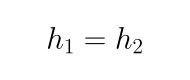
Where h = specific enthalpy of moist air (kJ/kg).
Air temperature reduction follows:
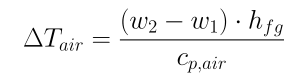
Typical achievable reduction under 25-40% RH:
- 4-9°C drop in dry-bulb temperature
- No surface wetting (non-saturated stream)
Example (typical Middle East climate):
- 42°C DB / 22% RH
- After adiabatic effect → 33-35°C DB
This temperature reduction occurs through isenthalpic cooling in the air stream, enabling dry-bulb reduction without saturation or surface wetting at the condenser.

Zero wetting architecture:
Smart Cooling operates with a fully dry condenser at all times. Adiabatic cooling occurs exclusively through evaporation in free air, upstream of the coil.
Atomized water evaporates in free air, not on surface
Air stream remains non-saturated at condenser inlet
No liquid water contact with condenser coil at any time
No biological growth
No mineral scale
No corrosion exposure
No additional coil cleaning cycles
Coil thermal conductivity remains unchanged:
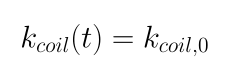
Unlike evaporative pads, where:
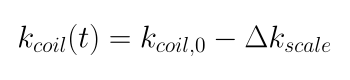
This preserves OEM thermal performance without deterioration.
For mission-critical infrastructure, maintaining stable thermal conductivity (kcoil) is the foundation of predictable PUE. By eliminating mineral deposition and fouling, Smart Cooling ensures that the cooling system operates exactly as engineered throughout its entire lifecycle. For the facility engineer, this transformation of a”variable” thermal degradation into a”constant” parameter translates directly to higher reliability and simplified maintenance planning.
Field operation changes after Smart Cooling
| Coil performance degradation | None |
| Inspection interval | Same as before |
| Cleaning | Same as before |
| High-ambient trip events | Reduced / eliminated |
For data center operators, the primary value of “Smart Cooling” lies in transforming the operational risk profile without increasing maintenance complexity. By maintaining standard inspection and cleaning intervals—while simultaneously eliminating the threat of high-ambient trip events and coil degradation—facilities can achieve higher availability and improved PUE stability. This ensures that the cooling infrastructure remains a predictable utility rather than a fluctuating point of failure.
Fail-Safe Logic
Upon:
- Abnormal pressure
- Abnormal humidity
- Water flow deviation
- Sensor inconsistency
- Communication failure
Upon any fault, the system automatically switches to Dry Mode in <1 second.
Chiller OEM control logic remains unaffected.
System uses PID-regulated adiabatic intensity, based on:
- Ambient dry-bulb (T_db)
- Ambient RH
- Condensing temperature (T_cond)
- Discharge pressure (P_dis)
- Chiller load %
- Airflow velocity profile (m/s)
Read more in our technical documentation

Modbus RTU / Modbus TCP
SNMP (optional)
Water pressure
Atomization rate
Adiabatic ΔT
Ambient conditions
System operating state
Fail-safe states

Typical reduction:
8-25°C lower discharge gas temperature
Lower compressor stress
Longer oil lifetime
Lower trip risk
Air-cooled chillers typically lose:
10-30% capacity at >40°C ambient
Smart Cooling compensates 70-100% of this loss, depending on chiller model.
Click here to see P&ID diagram.


Arizona Hyper-Scale: Avoiding Overbuild Example
To keep on-coil at 116 °F for 251 hot hours, Smart Cooling uses just 14,000 gallons water per chiller. Across all 130 chillers, the site total 1.8 million gallons.
Put simply: the water budget for an entire Hyper-Scale cooling plant equals the annual use of 2.5 small apartment buildings.
| Temp °F | TR / Chiller | Chillers | Total Cooling TR | Total Electric MW |
|---|---|---|---|---|
| 115.9 | ~450 TR | 130 | ~58 500 | 57.17 |
| 125.0 | ~426 TR | 138 | ~58 500 | 61.17 |
| 132.8 | ~383 TR | 153 | ~58 500 | 64.0 |
| 132.8 | ~315 TR | 186 | ~58 500 | 83.0 |
If you want to verify the real-world impact of these thermodynamic improvements, feel free to explore our validated field data from mission-critical installations:
Predictable condensing temp reduction
Consistent COP gain at high ambient

No wetting, no scale, no coil degradation
Fail-safe mission-critical reliability

Zero impact on chiller OEM logic

Verified in Tier III/ IV data centers
This system improves thermodynamic efficiency, reduces mechanical stress, and stabilizes air-cooled chillers during the most demanding thermal conditions.